Animal Facts
"I like pigs. Dogs look up to us. Cats look down on us. Pigs treat us as equals."
—Winston Churchill
87 results found. Go to page:
1 2 3 The dog was the first animal to be domesticated, around 12,000 years ago.
Oysters in their natural habitat open their shells at high tide and close them at low tide. Oysters moved from Long Island Sound to tanks in Evanston, Illinois, U.S.A. (near Lake Michigan) at first opened up at the time of high tide on Long Island Sound. By a few weeks later, though, the rhythm of opening and closing had shifted until the oysters were in tune with a non-existent tide, but one that would exist if Illinois were covered by the ocean.
When the Spanish conquistadors first reached Peru, centre of the Inca empire, the Peruvian Indians felt the Spanish horses to be ferocious and deadly monsters, there being no horses native to the Americas. Through an interpreter, they asked the Spanish cavalrymen what these animals ate. In response, the Spaniards, pointing to the gold jewellery and ornaments of the Peruvians, said, "They eat those things of yellow metal. They are hungry now but do not wish to be seen eating. Leave the food in front of them and go away." The Indians gathered some gold objects for the horses. After they had left, the Spanish pocketed the gold, and then, calling back the Indians, told them that the horses were still hungry and needed more food. (source)
Over the past 2,000 years, humanity has helped to cause the extinction of about 2% of the known species of the world's mammals. (source)
To make a one-pound comb of honey, bees must collect nectar from about two million flowers.
While the human body contains around 2,000 major muscles, an elephant's trunk contains nearly 10,000 muscles.
Perhaps the most strange annual culinary affair was hosted by Clodius, a rich Roman actor who had one hundred birds given voice lessons at a cost of approximately $250 per bird. He then had these birds made into a pie for his guests. He then offered a drink which contained a dissolved pearl worth about one-half million dollars.
The wandering albatross has the largest wing-span of any bird and can glide for six days without ever beating its wings. It can also sleep in mid-air. (source)
When a horse rises, it straightens its front legs first; when a cow rises, it straightens its hind legs first.
The heath hen was quite commonplace in New England in the 1600s. During breeding season, it nested on the ground and would stay there, guarding its nest, even when threatened. That made them easy targets for the Puritan inhabitants of New England, who ate the bird so frequently that they grew tired of it, and the dish was relegated to servants. By 1880, the heath hen could only be found in Martha's Vineyard, off the coast of Massachusetts. By 1932 the bird was extinct. (source)
The only bird that can fly backwards is the hummingbird, which achieves this feat by beating its wings up and down at a very fast speed; some species reach 80 beats per second. (source)
In De Rerum Natura ("On the Nature of Things"), the first-century B.C. Roman poet Lucretius wrote about how living organisms are constantly changing. He was aware of fossilized animals like none that currently exist and wrote that "Nothing remains forever what it was. Everything is on the move. Everything is transformed by nature and forced into new paths. One thing, withered by time, decays and dwindles. Another emerges from ignominy, and waxes strong." He also noted that many species must have died out in the past. (source)
The zebra is a black animal with white stripes, not a white animal with black stripes. The colouration cells in a zebra's skin are programmed to produce a black colour, and only when a genetic switch is thrown "off" do stripes without pigmentation (i.e. white bands) appear. (source)
In 1979, police in Schenectady, New York called to the home of 64-year-old Iva Fletcher came across an ankle-deep swarm of cockroaches stretching from the door to the street and into the trees. The officers estimated the cockroaches numbered in the hundreds of thousands, although an exterminator later estimated the number to be in the millions. The ambulance that took Fletcher to the hospital, an animal shelter van, and four police cars all had to be fumigated after the incident. (source)
Robert Burns had a pet ewe called Poor Maillie. He wrote two poems about her.
The sea-urchin walks on the tips of its teeth.
A recording of the alarm call of Pennsylvania crows was played for French crows. It caused the crows to gather, instead of fleeing as intended.
![[Riftia pachyptila]](../images/riftia_pachyptila.jpg) Riftia pachyptila
Riftia pachyptila.
Image credit: NOAA/Monika Bright.
Biologists divide the animal kingdom into as many as thirty-one different divisions, called phyla (singular phylum). One animal is so unique that it has its own phylum. In hydrothermal vents in the ocean floor lives a reddish worm, Riftia pachyptila, that creates a long, tough tube to live in. It ranges up to 25 feet long and ingests food, but has neither a mouth nor intestines. It is apparently nourished by bacteria that live inside its cells.
Generally, centipedes do not have 100 legs, nor do millipedes have 1,000 legs. Different species of centipedes have between 30 and 346 legs. Different species of millipedes have between 40 and 750 legs. (source)
Female praying mantises typically do not decapitate or eat their mates. It is believed that earlier scientists who observed this behaviour either forgot to feed the mantises or otherwise distracted them, leading to unusual displays of aggressive behaviour. (source)
Flatfish (halibut, flounder, turbot, and sole) hatch like any other "normal" fish. As they grow, they turn sideways and one eye moves around so they have two eyes on the side that faces up. (source)
One type of rat can go without water longer that a camel can. (source)
In Ancient Egypt, during the season when the Nile flooded, Egyptians would feed crocodiles by hand. (source)
The first successful corneal transplant was performed as early as 1835 by a British army surgeon in India whose pet antelope, who had only one eye, had a badly scarred cornea. He removed a cornea from a recently killed antelope and transplanted it into his pet's eye. The operation was a success, and the pet was able to see. (source)
King Christina of Sweden (all Swedish monarchs were given the title of King regardless of gender; only the spouse of a monarch would be called Queen) was so terrified of fleas that she ordered the construction of a tiny 10 centimetre long cannon so that she could fire miniature cannonballs at the fleas that infested the royal bedchamber. It is not known whether she ever managed to hit any. (source)
In the early 1980s, due to the risk of swine fever, all of the Haitian pigs, which were descended from mediaeval European pigs brought to Haiti during the seventeenth and eighteenth century, were eradicated by Haitian dictator Jean-Claude Duvalier. French scientists later "re-created" the extinct Haitian pig by crossing Chinese pigs with Caribbean and mediaeval Gascon breeds. When the Duvalier regime fell, the French sent their creation to Haiti.
The animal with the scientific name Puffinus puffinus is a Manx shearwater, not a puffin. (source)
The "koala bear" is a marsupial, not a bear.
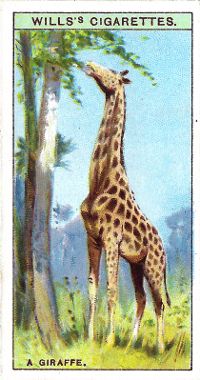
It has always been thought that giraffes have long necks because it enables them to reach food that other mammals cannot reach. However, recent research suggests that this may not be the full story. Most of the vegetation eaten by giraffes is below the height of their neck, where having a long neck would not be advantageous. However, having a long neck provides male giraffes with an advantage when mating, which may be explain why giraffes' necks are so long. (source)
King Alexandros I of Greece (1917–1920) died from blood poisoning after being bitten by his pet monkey. (source)
87 results found. Go to page:
1 2 3


![[Cigarette Card depicting a horse rising and a cow rising]](/images/wills-rising.jpg "A cigarette card from Wills' second \"Do You Know\" series, from around 1928, depicting a horse rising and a cow rising. Number 24 in the series of 50.")
![[an Egyptian crocodile]](../images/crocodile.jpg)