Strange Laws and Customs
"It usually takes 100 years to make a law, and then, after it's done its work, it usually takes 100 years to be rid of it."
—Henry Ward Beecher
49 results found. Go to page:
1 2 The oldest recorded death sentence is found in the Amherst papyri, a list of state trials of ancient Egypt, dating to 1500 B.C. A teenaged male, convicted of "magic", was sentenced to kill himself by either poison or stabbing. (source)
Oxford University once had rules forbidding students from bringing bows and arrows to class.
Marco Polo reported a strict sense of justice in India. If a man would not pay his debt, the creditor would draw a circle around the debtor. If the debtor should try to step out of the circle, he would be liable to punishment by death. (source)
View more facts about:
India Ben Jonson, the brilliant English dramatist and poet (1572–1637), was working as an actor and playwright in 1598 when he killed another actor in a duel. He was tried, and successfully defended himself by claiming the right of clergy, namely, that he could read the Bible in Latin, and was punished only by branding and a short prison sentence. (source)
View more facts about:
Crime When a Chinese bystander ashore was killed accidentally by a cannon salvo of greeting from an England ship, during the early days (1830s) of the China-Western trade, the England were forced to turn over to China the hapless gunner, who was promptly strangled. (Strangling was thought by the Chinese to be a less severe punishment than other forms of execution, because the body would not be permanently disfigured.) (source)
View more facts about:
China 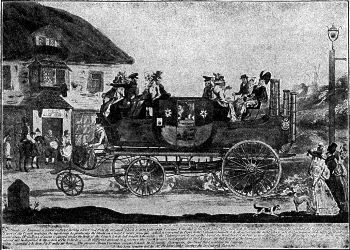
A steam coach that ran in Britain before the Road Locomotive Act was passed.
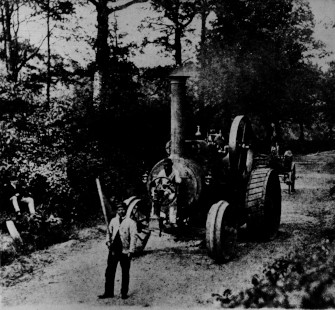
Steam traction-engine
Hero preceded by a man with a red flag.
From 1836 to 1895, the Road Locomotive Act (also known as the Red Flag Act) in England required that any self-propelled vehicle be preceded by a man carrying a red flag by day and a red lantern by night. It also placed high taxes on steam-powered vehicles. This regulation, by essentially limiting the speed of such vehicles to that of a person and otherwise making them impractical, inhibited the development of automobiles for 60 years in Great Britain. While previously Great Britain had been in the forefront of the development of automobiles and several steam coaches had been built, over the next six decades the French, Germans, and Americans would take the lead. (source)
In 1853 Illinois passed a law requiring any black entering the state and staying more than ten days to pay a fine of $50. If he could not pay, he could be sold into slavery for a period commensurate with the fine. (source)
In 1850, the state of Michigan's constitution read, "Neither slavery nor involuntary servitude, unless for the punishment of crime, shall ever be tolerated in this state," inadvertently legalizing slavery as an appropriate punishment for crime. It was not until 1963 when the comma was shifted from its position after servitude to a position after slavery, outlawing slavery as punishment for crime. (source)
On June 6, 1872, the U.S. Congress passed a bill exempting from duty, among other things, "fruit plants, tropical and semi-tropical". However, it was inadvertently printed as "fruit, plants tropical and semi-tropical". This misplaced comma cost the U.S. government $1,000,000 before a new session of Congress was able to rectify the error. (source)
Lawyer Harvey Silverglate estimates that, because of excessively vague laws, the average American unknowingly commits three felonies each day.
In the U.S. state of Illinois, it is illegal to hunt bullfrogs with a firearm. (source)
Witchcraft was not legalised in Great Britain until 1951. The last person in Great Britain to be convicted under the Witchcraft Act was Jane Rebecca Yorke, who was convicted in September 1944. She received a lenient sentence and a fine. (source)
View more facts about:
Lasts In Ottawa, Ontario, Canada, it is illegal to eat ice cream on Bank Street on a Sunday.
In Cleveland, Ohio, U.S.A., it is illegal to catch mice without a hunting licence.
In 1666, a law was passed in England requiring all corpses to be buried in a wool shroud, thereby extorting support for Britain's flagging wool industry, especially since the Black Death was devastating England at the time. The act was finally repealed 148 years later, in 1814.
In 1971, in order to show how easy it is to pass so-called "special bills", representative Tom Moore, Jr. introduced a bill in the Texas (U.S.A.) House of Representatives, which was subsequently passed unanimously, commending Boston mass murderer Albert De Salvo, who was known as "the Boston Strangler". The bill stated that De Salvo's "dedication and devotion to his work has enabled the weak and lonely throughout the nation to achieve a new degree of concern for their future", and that he was "officially recognized by the state of Massachusetts for his noted activities and unconventional techniques involving population control and applied psychology". (source)
View more facts about:
Crime
Duelling is legal in Paraguay as long as both parties are registered blood donors.
The following curious law was enacted during the reign of Richard I., for the government of those going by sea to the Holy Land: "He who kills a man on shipboard, shall be bound to the dead body and thrown into the sea; if the man is killed on shore, the slayer shall be bound to the dead body and buried with it. He who shall draw his knife to strike another, or who shall have drawn blood from him, to lose his hand; if he shall have only struck with the palm of the hand, without drawing blood, he shall be thrice ducked in the sea." (source)
In York, England, it is still legal to kill a Scotsman if he is carrying a bow and arrow and is within the city walls after dark, except on Sundays. (source)
In the U.S. state of Maine, it is illegal to deface a milk carton. (source)
![[Hammurabi]](../images/hammurabi.jpg)
Hammurabi.
In the code of laws of Hammurabi (1792–1750 B.C.), which is one of the first law codes in history and among the greatest ancient codes, the penalty for medical malpractice was for the doctor's hands to be cut off. (source)
In ancient Babylonia, if a poorly-built home collapsed on the owner, killing him, the architect was executed. If the owner's son was killed in the house collapse, the architect's son was put to death. If the homeowner's wife or daughter was killed, the architect was merely fined. (source)
View more facts about:
Crime Since 1624, Members of Parliament in the United Kingdom are not allowed to resign; they may only vacate their seats for reason of death, disqualification or expulsion. There is a loophole, though: A member who wants to resign can be appointed to a paid office of the Crown, which disqualifies the member from being a Member of Parliament under a 1680 resolution. So, since about 1750, when a Member of Parliament wants to give up his seat, he is appointed to be either the "Crown Steward and Bailiff of the three Chiltern Hundreds of Stoke, Desborough and Burnham" or the "Crown Steward and Bailiff of the Manor of Northstead." (source)
Under Massachusetts' Stubborn Child Act of 1654, parents could put their "stubborn" children to death. (source)
In Fairfax, Virginia, it is illegal to use a pogo stick on the city bus. (source)
In the city of Milwaukee, residents must keep pet elephants on a leash while walking them. (source)
In Kern County, California, it is illegal to play bingo while drunk. (source)
In the United Kingdom, it could be considered an act of treason to place a postage stamp bearing the reigning monarch's image upside-down. (source)
It is illegal to die in the United Kingdom's Houses of Parliament, and it is also illegal to enter them wearing a suit of armour. (source)
It is illegal to drive while blindfolded in the U.S. state of Alabama. (source)
49 results found. Go to page:
1 2

