Unexplained
"We know no more our own destiny than a tea leaf knows the destiny
of the East India Company."
- Douglas Adams
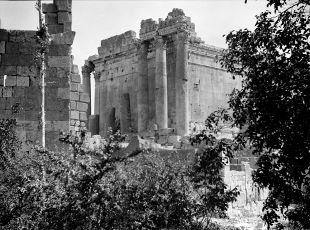
Ruins at Baalbek.
At Baalbek, 53 miles from Beirut in Lebanon, stand the ruins of several Roman temples that were constructed in the first century A.D. A massive stone wall surrounds the temples. At the western end of the wall lie three of the largest blocks of cut stone in the world; the largest is 64 by 14 by 12 feet and weighs around 800 tons. This block would have to have been cut from a quarry almost a mile away, transported to Baalbek, and may have had to have been lifted up to 25 feet in the air in order to be placed in its final position. Few modern industrial cranes are capable of such a feat; however, the stones are placed so precisely, it is impossible to insert the blade of a knife between them. It is not known how these stones were transported.
A broch is a circular iron-age structure found only in Scotland. Standing up to five storeys in height, they are built from stone, with no mortar used to bind the stones. Their purpose is unknown. Over 100 are known in Scotland.
In October 1969, in the woods of Yrjo Kanto in the Palloneva region of Finland, farmer Heino Seppi, splitting an aspen log, discovered a rotten middle of the log forming a hollow that contained a dry fish around 1.3 feet (40 centimetres) long. It is not known how the fish got there. (source)
The largest human figure in the world is the Long Man of Wilmington, at 231 feet 6 inches tall. It stands on the edge of the downs near Eastbourne (East Sussex) and holds a staff in each of his raised hands. The figure is of unknown origin; it is not known whether it was first cut by a prehistoric tribe or as late as the eighteenth century. (source)
On August 31, 2004, an unconscious, severely beaten man was found behind a dumpster at a Burger King in Richmond Hill, Georgia. The man had no identity documents on him, and when he woke up he had amnesia and could only remember his first name, Benjaman, and could not remember his last name or any relevant details about his life. Even though there was significant media coverage, and even with the aid of modern technology, his identity could not be determined for 11 years.
![[Lemon trees]](../images/lemon_trees.jpg)
Lemon trees.
The origin of the lemon tree is unknown. Crusaders discovered the trees in the holy land, but the trees are not from there originally.
On October 13, 1928, at Charfield, England, an express train hit a freight train, and another freight train ran into both, killing 16 people. Among those killed were two children, a girl aged about eight and a boy aged about eleven, who had boarded the train in Birmingham. Despite the efforts of many people, these children were never identified. (source)
On the morning of New Year's Day, 1963, Dr. Gilbert Stanley Bogle, one of Australia's top physicists, and his girlfriend Margaret Chandler were found dead in suburban Sidney, Australia, near Fuller's Bridge, on the Lane Cove River. The best efforts of the Sydney police, Interpol, and the FBI notwithstanding, no-one has been able to figure out who killed them, how they were killed, or why they were killed. This case is unique in that all three of these questions are unanswered. (source)
View more facts about:
Crime It is not known exactly what gravity is. We can define what it is as a field of influence, and with general relativity we can think of it as being a property of our real world mathematically equivalent to not just the geometry of space-time, but equivalent to space-time itself. Some believe that the gravitational force is transmitted by particles called gravitons that travel at the speed of light just as photons do. In any true fundamental sense, we do not know what gravity is, we only know how it operates in various corners of our universe. Without gravity, there would be no space and time. (source)
Having lasted for six centuries, the civilisation known as Classic Mayan culture collapsed abruptly in the ninth century, for reasons still not yet understood. Several theories have been proposed, such as an epidemic, natural disaster, civil war, invasion, poor farming methods leading to exhaustion of the soil, or climate change resulting from clear-cutting. The collapse occurred quite quickly. Within about a century, inscriptions ceased to be carved at every Mayan city, and the Mayan population shrank by about ⅔ over the span of a century. (source)
The Nazca lines in Peru are not the only pre-Columbian drawings only visible from the sky to be found in the Americas. In the southeastern California desert near Blythe is a 167-foot-long figure of a man. Other figures were visible before World War II, until Blythe was used as a military training area and tanks and other vehicles obliterated many of them. Dating methods have dated the figures to around the year 900, give or take 100 years. Interestingly enough, one of the remaining figures appears to look like a horse, but the horse was not present in North America around that time. (source)
In the Pampa Colorada (Red Plain) in the Peruvian Desert, there are large line-drawings of geometric shapes, animals and plants on the desert soil. These drawings are known as the Nazca lines. These were likely drawn by the Nazca Indians approximately 2,000 years ago. These figures are only fully comprehensible from the air. In fact, in 1937, before flight was commonplace, a highway was constructed through the Nazca lines, as no-one was yet aware of the lines' significance. It is unknown how the drawers achieved such geometrical precision in their art, or why they would draw figures that they could not view. (source)
Cyprus was an important mining centre in antiquity, but during Roman times, for reasons still unknown, operations were halted and the tunnels sealed. Many of the tunnels were found and reopened in the 20th century, due to clever detective work by an American mining engineer, D. A. Gunther. In the New York Public Library, he had stumbled on an ancient account of the mines. Years of ingenious searching in Cyprus led him to find the tunnels, which were still in workable order with usable support timbers and oil lamps. This discovery resulted in Cyprus becoming an important mining centre again. (source)
Off the coast of Nova Scotia lies tiny, irregular-shaped Oak Island. In 1795, Daniel McGinnis and two friends found an old ship's tackle block hanging above a filled-in depression on the island. They dug thirty feet down, finding three oak platforms at ten-foot intervals. Nine years later, a more concerted effort to uncover what lay underneath began. More oak platforms were found, as well as a "cipher stone" in obscure symbols that were interpreted to indicate an enormous treasure below. Several channels were later found that connect to the island's beaches that serve to flood the shaft with water. Even with the benefits of modern technology, the bottom of the pit, and the treasure supposedly there, has not yet been uncovered. It is also not known whose treasure it is, or why they went to such trouble to bury it. (source)
In 1877, during the height of violent labour unrest in the United States, three men were found guilty of the murder of a foreman of the Lehigh Coal and Navigation Company and sentenced to hang. Two of them went stoically to their deaths, but the third, Alexander Campbell, swore that he was innocent. As he was being dragged from his cell to the gallows, Campbell rubbed his left hand in dust from the floor and pressed his palm against the plaster wall, and shouted repeatedly, "This handprint will remain here for all time as proof of my innocence." And so it did. In 1931, Carbon County Sheriff Robert L. Bowman undertook a renovation of the cell, removing the section of plaster wall containing the handprint and replacing it with a new section of fresh plaster. Nonetheless, the handprint came back, and still exists today. (source)
On December 1, 1948, a man was found, dead, on Somerton Beach, Australia. Police were unable to identify the man, who carried no identification or passport, just cigarettes, tickets, gum, a comb, and, most interestingly, a scrap of paper with the words tamam shud, Persian for "it is finished," printed on it. It was determined that this was the final page of The Rubaiyat of Omar Khayyam. Following a police appeal for the book, a man turned the book in, saying that he had found it on the front seat of his unlocked car around the time of the murder. On the inside back cover of the book were a jumble of letters; police assumed the writing to be some sort of code, but cryptologists were unable to break the code. Furthermore, a coroner's inquest was unable to determine a cause of death, although some sort of poison was suspected. To this day, the identity of the man, the cause of death, and the meaning of the code are all unknown.
In 1867, a falling tree severely injured Belgian Pierre de Rudder's left leg. A surgeon had to remove a piece of bone that had become lodged in tissue, leaving the leg bone separated by a space of over one inch. The leg, which had an open wound and the lower part of which could be manipulated in all directions, was useless, and doctors said nothing could be done except for amputation. In 1875, Rudder went to the Shrine of Our Lady of Lourdes in Oostakker, arriving on April 7. Sitting on the ground, he prayed, asking to be able to work again. He felt deeply moved and then rose, walked through the crowd and knelt before the statue before realizing that he was walking again. The wound had closed and the leg appeared normal. After his death in 1898, one of his doctors, Dr. Van Hoestenberghe, performed an autopsy. He found that the bones of the left leg were still deformed, but the legs were of equal length so that the weight of the body was equally supported, and there was a healthy white piece of bone over one inch long that connected the two sections that still showed traces of breakage. (source)

