Ancient Egypt Facts
"Cheops' Law: Nothing ever gets built on schedule or within budget."
Robert A. Heinlein, Time Enough For Love
31 results found. Go to page:
1 2 The word "pyramid" comes from the Greek word "pyramis," which means "wheat cake." To the ancient Greeks, the pyramids of ancient Egypt reminded them of wheat cakes with pointed tops. (source)
The Egyptian calendar, which was 365 days long and started on the day that Sirius rose in line with the sun, was instituted around 4,241 B.C. (source)
The great architect of ancient Egypt, Imhotep (2,655–2,600 B.C.) is the earliest scientist who is known by name today. We also know the names of other ancient Egyptian architects, scientists, and mathematicians, such as the scribe Ahmes. On the other hand, China, Sumeria, and Babylon did not record the names of their early scientists. (source)
The use of cosmetics dates from around 5,000 years ago in ancient Egypt. Their original use was to protect skin from sunlight, rather than for beauty care. (source)
Hatshepshut (reigned circa 1494–1482 B.C.) was neither the only female pharaoh of Egypt nor the first. Sobeknefru reigned from around 1790–1782 B.C., and evidence exists suggesting that Nitokris reigned from around 2184–2181 B.C. (although it is unclear if she really existed) and that Merneith reigned sometime in the 30th century B.C.
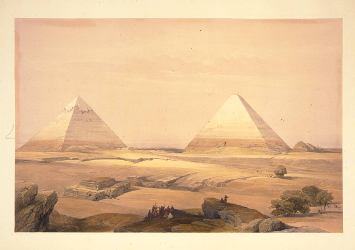
The Great Pyramid of Cheops (Khufu) at Giza, built around 2,570 B.C., used 2,300,000 large stone blocks that weigh a total of 7 million tons.
In terms of volume, the largest pyramid in the world is in Mexico, not Egypt. Called the Cholula Pyramid (sometimes referred to as Quetzalcoatl), it was built around the year 100 at what is now Cholula de Rivadahia (near Puebla) from sun-dried brick and earth. Although only 177 feet high, less than 40% of the height of Egypt's Great Pyramid of Cheops (Khufu) at Giza, it covers an area of 39.5 acres. In contrast, the Great Pyramid is 480 feet high but covers an area of only 13 acres. It has been estimated that the Mexican pyramid has a volume of 4,300,000 cubic yards as compared with the Great Pyramid's 3,360,000 cubic yards. (source)
There are cavities in the Great Pyramid of Cheops (Khufu) at Giza, possibly totalling up to 15 to 20 per cent of the structure, that appear to contain sand, not from the site of the pyramid but from another part of Egypt. (source)
The pyramids of Egypt, the oldest of the seven wonders of the ancient world, are the only one of those wonders to survive to the present day. (source)
The earliest known last will was made by Nek'ure (died circa 2601 B.C.), son of the Egyptian Pharaoh Khafre. It was carved on his tomb. Beginning by asserting that Nek'ure had made his decisions about his property "while living upon his two feet and not ailing in any respect", it goes on to dispose of 14 towns and two estates to his wife, three children, and another female. (source)
View more facts about:
Lasts The earliest description of the circulation of the blood may be found in the Edwin Smith surgical papyrus, a papyrus from ancient Egypt that was dated to 1600 B.C., but is believed to be a copy of an older work written as early as 2500 B.C. and attributed to Imhotep. (source)
Pharaoh Pepi II of Egypt, who reigned from around 2294 B.C. to about 2220 B.C., had the longest known reign of any monarch (74 years; some sources credit him with a longer reign, as long as 94 years). Other long-reigning monarchs were King Alfonso I of Portugal (1112–1185, 73 years), King Louis XIV of France (1643–1715, 72 years), Prince John II of Liechtenstein (1858–1929, 71 years), and Queen Elizabeth II of the United Kingdom (1952–2022, 70 years). (source)
In order to deter flies from landing on him, Pepi II of Egypt always kept several naked slaves nearby whose bodies were smeared with honey. (source)
![[Title of the Rhind Mathematical Papyrus]](../images/rhindpapyrus.jpg)
A portion of the Rhind Mathematical Papyrus containing the work's title.
One of the oldest surviving works about mathematics (the Rhind Mathematical Papyrus, written by the ancient Egyptian scribe Ahmes around 1650 B.C.) is entitled "The Entrance Into the Knowledge of all Existing Things and all Obscure Secrets". (source)
When the troops of ancient Egyptian Pharaoh Thutmose I invaded Syria and Carchemish on the upper Euphrates in 1525 B.C., they were astounded to see the Nile "falling from the sky" and a river that "in flowing north flowed south." The soldiers only knew Egypt and the Nile, and so were fascinated to see rain (the Nile falling from the sky) and the direction of the flow of the southward-flowing Euphrates; to the Egyptians, south meant "upstream", so they saw the Euphrates as flowing "backwards". (source)
Pharaoh Ramses II was soundly defeated by the Hittites at the Battle of Kadesh in 1288 B.C. Undaunted, the Egyptian pharaoh erected a memorial to commemorate his magnificent "victory". The monument endured, and generations of historians saw the Battle of Kadesh as an Egyptian victory. Only recently have archaeologists unearthed the facts about the Battle of Kadesh. (source)
The oldest recorded death sentence is found in the Amherst papyri, a list of state trials of ancient Egypt, dating to 1500 B.C. A teenaged male, convicted of "magic", was sentenced to kill himself by either poison or stabbing. (source)
In ancient Egypt, slaves are known to have been murdered to accompany their deceased owners to the afterlife. (source)
Egyptian pharaoh Amenhotep IV (reigned circa 1351–1334 B.C.), who renamed himself Akhenaten, was the first recorded monotheist in history. He decreed that Aten was the only god to be worshipped, and images of the old official god, Amun, were destroyed. However, this revolution did not affect the general population of Egypt, who continued to worship their own regional gods, nor was it long-lasting, since after his death the old gods were reinstated. (source)
The first recorded use of the flute, clarinet, oboe, and trumpet was in ancient Egypt.
View more facts about:
Music The ancient Egyptians played a game similar to bowling, with large stones set up as pins and small stones for a ball.
Some ancient Egyptians slept on pillows made out of stone. (source)
While the use of antibiotics did not begin until the 20th century, early folk medicine included the use of mouldy foods or soil for infections. In ancient Egypt, for example, infections were treated with mouldy bread.
The ancient Egyptians used hieroglyphics only for ritual purposes and official inscriptions. For everyday use, a script known as hieratic was used, and starting around 700 B.C., a second script known as demotic was used. Both of these scripts were written using a brush on papyrus. (source)
The earliest known standard of weight is the beqa, an ancient Egyptian unit which equals from 6.66 to 7.45 ounces. It is still generally used in weighing gems, precious metals, and stones in troy weight. (source)
More damage has been done to Cleopatra's Needle, a hieroglyphic-covered granite obelisk, in the 125 years it has stood in pollution-filled, weather-beaten New York City than in thousands of years in dry Egypt. (source)
The ancient Egyptians, and other ancients, defined the hour to be one-twelfth of the time between sunrise and sunset. So, as the days grew longer in winter and spring and shorter in summer and autumn, the length of the hour varied from one day to the next.
The last hieroglyphic inscription was made in 394 A.D., and the last demotic inscription in 452 A.D. Both were found at the temple of Isis in Philae, in the south of Egypt.
It is not known who destroyed the nose of the Sphinx. There are sketches of the Sphinx without a nose in 1737, over 60 years before Napoleon reached Egypt and hundreds of years before the British and German armies of the two World Wars. The only person known to have damaged it was an Islamic cleric, Sa'im al-dahr, who was lynched in 1378 for vandalism.
It is not known exactly when or by whom the Sphinx was built or whom it represents.
31 results found. Go to page:
1 2


![[Rock wall in front of pyramids]](../images/rock_wall_by_pyramids.jpg "Rock wall in front of pyramids")